
Green Book Reports
War on Gaza
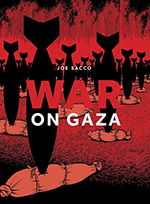
by Joe Sacco, (2024) Fantagraphics Books, 30 pages. Available at the Corvallis Benton County Library, call number GRAPHIC 956.94055 SACCO
Portland comic book artist Joe Sacco is the author of two previous longer format graphic novels about Palestine, Palestine (1993) and Footnotes on Gaza (2010). All are available at our public library. This recent short compilation of polemical images and stories was prepared as a response to the current genocide being committed by Israel with the full backing of the United States. Sacco addresses the futility of nonviolent resistance, which was met with lethal violence by the Israeli Defense Forces. He explores the duplicity, lies and apparent senior dementia of the Biden administration as it sought to justify the unjustifiable. Sacco creates a modernized version of the destruction of Sodom and Gomorrah in which Joe Biden is turned into a pillar of votes for Jill Stein when like Lot’s wife he ignores the warning to not look back at the carnage. The most moving part of this collection is an illustration of his guilt, as an American citizen, who pays taxes to support the murder of Palestinian children. Although he writes and draws with humor, Sacco effectively evokes the outrage needed at this time in history.
Tribal Histories of the Willamette Valley
by David G. Lewis 2023, Ooligan Press, 238 pages. At the Corvallis Benton County Library, call # 970.00497 LEWIS.
The author is a professor of anthropology and Indigenous studies at Oregon State University, and a member of the Confederated Tribes of the Grand Ronde. He writes a blog, the Quartux Journal
I highly recommend this book for anyone living in Willamette Valley. It recounts the experience of the Kalapuya, the indigenous people of the Willamette valley, from the start of the 19th century to today. It gives insights to the lived experiences of indigenous people as their homeland was taken over by settlers. Here is a simplified summary of that history:
Kalapuya lived in the Willamette Valley for over 10,000 years. Starting in the 1770s, epidemics of European introduced diseases, primarily malaria, reduced the population of the Kalapuya by more than 90%. Large numbers of white settlers began arriving in the 1840s encouraged by grants of 640 acre allotments. Kalapuya were impressed by the possession of metal tools, cattle and horses and new agricultural and housing technology of the settlers. However, conflicts started as the number of settlers increased and they demanded the displacement of Kalapuya from the most desirable lands. Oregon City, Salem, Lebanon and Eugene were major population centers of Kalapuya people before the white invasion. Settler agricultural practices destroyed resources essential to the livelihood of the Kalapuya such as camas and wapato. In 1851 a series of 19 treaties were negotiated to ensure the rights of tribes on dedicated reservations, separated from settler communities. The treaties included promises of home construction, schools, healthcare, clothing, agricultural implements and cash. Many Kalapuya relocated based on these promises. Settlers immediately occupied the abandoned lands. However, the US Congress refused to ratify the treaties. Kalapuya lost their homelands without compensation. A treaty negotiated in 1855, and subsequently ratified, established the Grand Ronde reservation. Federal Indian agents attempted to move all Willamette Valley Kalapuya to Grand Ronde with the same inducements, now with the guarantee of a ratified treaty. However, the promises were never kept because Congress would not allocate adequate funding. Kalapuya on the Grand Ronde remained impoverished. Starting in 1887, allotments of 260 acres of reservation lands were granted to some individual Kalapuya on the Grand Ronde reservation. Many allotment applications were never processed. The government then sold unallotted lands to white farmers. In the 1950s tribal recognitions were terminated, ending all obligation of the federal government to indigenous people, and making indigenous people citizens of the United States. Oregon laws prohibiting sale of alcohol and marriage to white people were overturned in 1952. Restoration of tribal recognitions began in 1977 and are still in progress for some tribes. The most recent in Oregon was the 1989 restoration of the Coquille tribe.
The book ends with some ideas about restorative justice. Indigenous people joke about lands acknowledgements, “Yeah, we have your stuff, yes, it is your stuff, but you can’t have it back.” The Lands Back movement has seen some voluntary private donations of land to tribal ownership. Major state and federally owned lands could be returned to tribes, but they would require accompanying funding for management. Certainly, any resources extracted from lands illegally taken from tribes should be accompanied by compensation to tribes. Oregon State University, which was built on unceded tribal land could offer free tuition to tribal students as compensation for the stolen land.
The Green Corn Rebellion

by William Cunningham (1935), published by the University of Oklahoma Press, available at the Corvallis Benton County Public Library in fiction under the author’s name.
The Green Corn Rebellion is a fictional account of Oklahoma farmers who participated in the summer of 1917 rebellion against the United States government. Thousands of poor farmers were organized by the Working Class Union in opposition to the draft and the slavery-like institutions of sharecropping and land tenancy. In Hughes, Seminole and Pontotoc Counties where the rebellion occurred more than 60 % of farmers were tenants. The novel does not give a detailed account of the rebellion but focuses on the lives of a few farmers and the experiences that brought them into the rebellion.
The rebellious farmers were associated with the Socialist Party, whose leader Eugene Debs was jailed for his outspoken opposition to the draft and US involvement in the European war. However, the Socialist Party did not endorse the rebellion and in a meeting with a Socialist leader portrayed in the novel he advises them to go home and not even speak of revolution. The farmers envisioned a mass uprising that would gather strength as they marched toward Washington, where they intended to depose Wilson and install a revolutionary workers’ government. The farmers were largely motivated by an urban rural divide. They saw people living comfortable stable lives in the towns, benefiting from the exploitation of the working farmers, who were going deeper into debt with each crop cycle. The rebellion was multi-racial multi-ethnic. Participation of Black and Cherokee farmers is portrayed in the novel.
The group in the novel assembled a militia of several hundred volunteers and waited for word from WCU leadership to start the march to Washington, DC. The marching orders never came. Instead, a mob of armed deputized town citizens came to arrest the insurgents. The rebel volunteers were not willing to fire on their town neighbors and relatives, so they dispersed. Later, posses of deputized townsfolk arrested and/or killed individual leaders at their homes.
The father-in-law of the novel’s protagonist, Jim Tetley, is beaten to death while on the way to Leavenworth Prison. Jim Tetley is blackmailed and coerced into enlisting in the army, where he hopes to die rather than return to the miserable slavery of Oklahoma farm life. The novel ends with defeat and demoralization. However, there are glimmers of hope. In his final visit with his month’s old son, Jim tells the baby that maybe his generation, or the next, will find the numbers and leadership to overcome capitalism and establish a workers’ government. As Jim Tetley boards the train to boot camp he sees the headline of the newspaper, “Lenin and Trotsky Seize Power in Russia.” The novel is a tragic story of enlightenment for Jim Tetley, who matures from a guiltily lazy, self-centered oppressed victim of capitalism, to become a defeated hero of the working class through his rebellion.
The description of impoverished rural life In The Green Corn Rebellion is reminiscent of Timothy Egan’s The Worst Hard Time, Willa Cather’s My Antonia, and John Steinbeck’s The Grapes of Wrath. The writing is clear, with engaging characters, and overall entertaining. This edition has a 20-page introduction that provides historical background, literary/political analysis and biographical information on the author.
The Hammer : power, inequality, and the struggle for the soul of labor

by Hamilton Nolan, Hachette Books, 2024. Available at Corvallis Public Library - Adult Non-Fiction Book 331.8 NOLAN
Hamilton Nolan reports on successful union organizing efforts around the USA. Some, such as home childcare workers in California, are in situations that traditional “big labor” would consider impossible to organize with individual contractors working in isolation. He also describes the paralysis that has overcome the labor movement as what were once powerful unions have retreated to “business unionism” that focuses only on protecting the perks of their diminishing membership, losing sight of the role of organized labor as protectors and advocates for the entire working class. Nolan sees growing inequality as the greatest threat to the nation. And he sees organized labor as the only force that could reverse the national and global transfer of wealth and power to the wealthy and powerful. Throughout Nolan’s narrative, he blends in the story of Association of Flight Attendants-Communication Workers of America (AFA-CWA) President Sara Nelson. He provides a very flattering image of Corvallis, OR, where Nelson was born and raised. He doesn’t say so, but possibly she was exposed to Howard Zinn’s A People’s History of the United States which was used as a textbook at Corvallis High School. In 2018-19 Nelson was instrumental in ending a federal government shut down when she threatened a general strike of all air transportation workers. Nolan describes Nelson’s aborted 2021 campaign to take over the leadership of the AFL-CIO. Nolan sees Nelson as the embodiment of the spirit of organizing that is lacking in the AFL-CIO. Without a powerful growing labor movement, the Democratic party has no loyalty to, or need for, working people. Democrats have become the second wing of the oligarchs’ representation in government. Only a resurgent union movement animated by a vision of people power can force government to start representing people rather than capital.
The Message
by Ta-Nehisi Coates Library - Adult Non-Fiction Book # 921 COATES, TA-NEHIS
The Message by Ta-Nehisi Coates, renowned professor, speaker, and author, brings us right into his classroom as this book begins. He is addressing his students and unfurling the joy, power, and pain that can be shared through the written word. He encourages all of us to write down what we witness, to make art of the history happening all around us, and to ever stop creating and seeking meaning. The Message centers three experiences that highlight Coates’ evolving beliefs. While Coates's section on Palestine has garnered the most attention in the media, all three sections of the book pull together the message he's conveying. We embark on his journey to Senegal as he explores his own ancestors’ experience of violence and enslavement. And on to South Carolina to join a meeting of folks protesting his own book being banned, reminding us of the power of books and the absolute necessity of protest. And finally to Palestine, where he spends only a short time but of course long enough to see the apartheid clearly baked into the colonizer’s rule. Coates details the daily horrors and the resilience of the Palestinians. The overlap of the history he explores in West Africa and the American South, with the present day violence he witnesses in Palestine, reinforces just how strong the struggle against white colonialism has always been and remains to this day.